The first thing to understand about humans is that humans-don’t-really-think. Their meat-brains automatically react to external stimuli based on their previous programming. For example: some people see rocks on the planet Mars and their meat-brains auto-respond “face”. Immigration restriction causes some people’s meat-brains to auto-respond “racist”. This is the vaunted “thinking” of the “wise man” homo sapiens.
Humans trust their meat-brains and rarely question them by asking actual thought-provoking questions like:
- What’s the evidence for this?
- Could this be only partially true?
- Could there be other explanations?
Although humans live and evolved in a world of geography most of their conscious thinking is word-based. Humans rarely try to think conceptually based on geography:
- Visualize the raw data of reality as dots on a piece of paper
- Put boxes around certain dots to indicate helpful concepts (Example: that data we are receiving from our eyes in an “apple”)
- Consider the borders of the conceptual-box for edge-conditions (Example: is the stem of the apple part of the apple or not?)
- Consider how those same dots can be part of other conceptual-boxes (Example: that apple is fully part of the tree and the apple pie is partly made of apples)
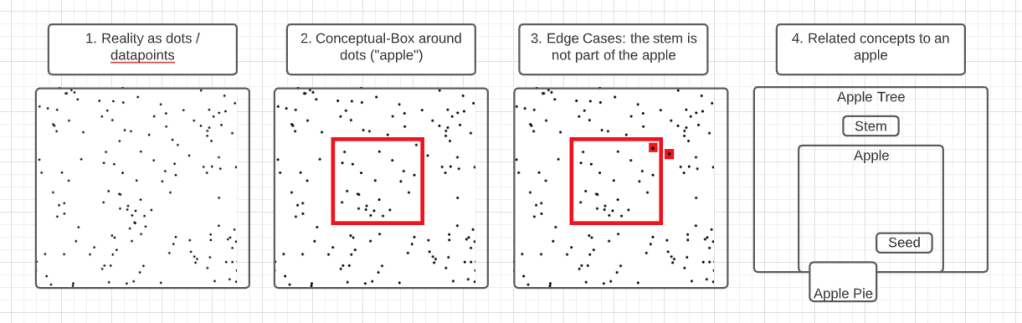
This geographic way of thinking aligns nicely with the previous three questions:
- What are the dots inside the conceptual-box? (evidence)
- Are there edge-condition dots that don’t belong in the conceptual-box or others that should? (partiality)
- Are there other conceptual-boxes that contain some of the dots? (plurality / other explanations)
Let’s go back to the curious automatic “thought” that immigration restriction is racist. We can do this by looking at polling data in response to the question “Is it racist for a white person to want less immigration for ethnocultural reasons?” We get this polling data from Eric Kaufman author of the book Whiteshift: Populism, Immigration, and the Future of White Majorities
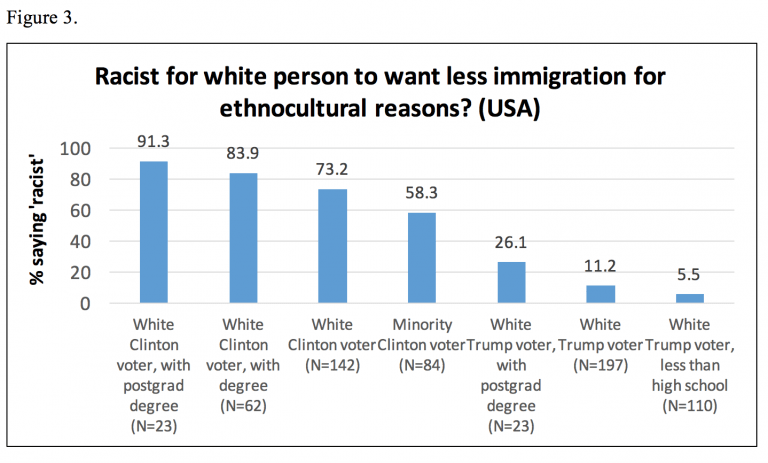
(Image from: https://blogs.lse.ac.uk/politicsandpolicy/antiracism-norms-and-immigration/)
What we see from the polling data is that there is not agreement and that different types of people responded in different ways. Everyone most likely agrees (based on their programming) that racism is wrong. Yet some people were seeing racism and others were not. We can use the three thinking questions (or geographic modeling) to attempt to gain some insight.
Let’s consider the first thinking question: “What’s the evidence for this?” Well, it seems straight forward that racial preferences are racist. Some would further say that racial preferences imply you consider certain races superior to other races. So why isn’t there unanimous agreement? Maybe the next question will provide an answer.
So, let’s consider the second thinking question: “Could this be only partially true?” This seems to be where much of the disagreement arises from. Are all racial preferences racist? Are dating preferences racist because you are physically more attracted to members of your own race? And what about cultural compatibility in your dating preferences or in where and with whom you want to live. And what about a sense of responsibility and aesthetic concern for your cultural and ethnic transmission (from parents to children)? And what about wanting to slow ethnocultural change to limit cultural disruption? In the geographic way of thinking these are edge-conditions of the conceptual-box “racist”.
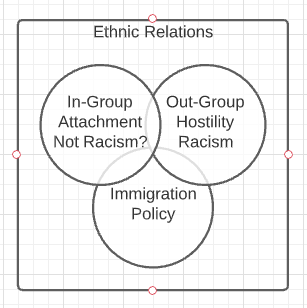
And finally, let’s consider the third thinking question: “Could there be other explanations?” The other explanation that Kaufman offers is to step back from racism and say that racism is a subset of ethnic/racial relations. He says that ethnic/racial relations can have at least two subparts: (1) outgroup hostility (racist) and (2) ingroup attachment (fewer people consider this racist). Therefore, wanting to reduce immigration can be about hating outsiders or it can be about an attachment to the current ethnocultural makeup of your society and an associated preference to limit disruption to that ethnocultural makeup.
The geographic conceptual-modelling method visualizes the three sub-concepts: ingroup attachment, outgroup hostility, and immigration policy as overlapping circles (box-based Venn diagrams are ugly) within a larger conceptual-box of ethnic-relations.
Through the more deliberate process of either asking simple questions or through conceptual-modelling we are able to move beyond the “not really thinking” of most people and into actual thinking.
Summary
- Humans-don’t-really-think: “humans get answers automatically from their meat-brains; and rarely bother to question those answers”
- A simple way to do more deliberate thinking is by asking and answering a few questions:
- “What’s the evidence for this?” “concept-composition
- “Could this be only partially true?” / “Yes, and no…”: concept-partiality
- “Could there be other explanations?” / “Yes, and other explanations too…”: concept-plurality
- You can also use visualization (concept-modeling) to help your understanding. Visualize reality as dots on a piece of paper (raw-data-of-reality) and concepts as boxes that contain those dots (conceptual-boxes) and then ask the following questions
- What are the dots inside the conceptual-box? (evidence / concept-composition)
- Are there edge-condition dots that don’t belong in the conceptual-box or others that should? (concept-partiality)
- Are there other conceptual-boxes that contain some of the dots? (other explanations / concept-plurality)
- Warning: thinking is not just about the search for truth. A large part of thinking is about communication and collaboration; and those activities require that people mostly agree on how to interpret things. When you start thinking differently you can cause social conflict and get yourself in trouble.
 Key Square