On Winning

“To every man upon this earth, death cometh soon or late. And how can man die better, than facing fearful odds, for the ashes of his fathers, and the temples of his Gods.”

  1. What is winning?  Winning is the elevation of the good, the beautiful, and the true.  Winning is the continuous flourishing of our people in ecological harmony with nature or nature’s god (GNON).
  2. We don’t have to save everyone; we should therefore lower our expectations to eventually saving perhaps only a small percentage of our people.
  3. We don’t have to take power right away; the first step is just surviving.
  4. Surviving is an active process against entropy that requires energy and intellect.
  5. Subsequent steps beyond mere surviving are just that, steps.
  6. Subsequent steps also need to be actively maintained against entropy.
  7. The survival and flourishing processes are never-ending and require constant effort and intelligence.
  8. Take the Irish perspective, the battle against colonialism was long and most of those who fought against it died as losers.  Yet those dead losers were recast as heroes when the movement finally succeeded.
  9. A revolutionary vanguard does not have to be more than 100 people and often can be much smaller than that.
  10. Everyone should contribute a little and some should contribute everything.

NPCs are enslaved by moral-debt

For the longest time I was confused why when reading political opinion articles written by American blacks they would constantly and at great length and with great emotionality keep bringing up slavery, Jim Crow, segregation, redlining, personal accounts of racism, and more recently personal accounts of racist micro aggressions.  My somewhat autistic brain would be impatiently reacting, “Yes, yes, I know about racism, so, get to the point.”  I wanted them to skip to the details of policy they were arguing for so I could consider its merits (merits which include concerns over race and racism).  I was however missing that the main point of the opinion article was the “racism is bad” preamble and the actual policies were much less important than making people feel guilty so they would support the broader concern of black (special) interests in general.  The point was to create a moral-debt within white people so they would feel obligated to give in to black demands based more on that indebtedness rather than based on careful judgments over the specifics of the policy recommendations.  “You owe me for past injustices, you should feel guilty, and now you have to repay that debt by doing what I want you to do, even if you don’t like it, and even if it may be bad for you.”

This coercion (if effective) seems to run counter to the NPC-think model where people rarely change their beliefs based on argumentation.  To address that weakness: we can add the concept of NPC-reciprocity.  It is not unusual for people to do favors for other people they like, sometimes with the unstated and unconscious expectation that this person will return the favor in the future.  So, generating moral-debt is not so much about changing a person’s beliefs but rather about coercing them to into an obligation for reciprocal repayment.

Advice: Watch out for and callout when someone is trying to guilt you into moral-debt.  Be sure to acknowledge that you might indeed have a moral debt to them and then widen the frame. “Yes, you deserve to be heard, and yes, you may be partly correct that I am indebted to you, so yes, let’s discuss that, and then afterwards let’s broaden the discussion to also include my concerns and discuss the specifics of what we might do.”  With their (most likely unconscious) tactic of attempting to guilt you now on-the -table rather than hidden you have a much better chance to react to and limit their coercion.

Summary

  • Moral-debt: make another person feel morally obligated (guilty) so they perform actions to repay that debt.
  • NPC-reciprocity: exchange favors, do a favor as a deposit for a future payback, collect a favor to repay a debt.

NPCs are lynching volcano mobs of cops that have cockroaches in their soup

The third thing to understand about humans is that they are extremely dangerous.  Picture yourself as a humble cockroach enjoying a meal, suddenly there is a loud scream, and you are violently tossed up into the air, you then come crashing down to the earth, and are momentarily dazed before you quickly scurry for safety, until a boot crushes you dead.  Another poor humble cockroach murdered by the super predator that is humankind.

Yet from the human perspective this murder is perfectly justified, and to add insult to injury (death) the speciesist (“intolerance or discrimination on the basis of species, especially as manifested by cruelty to or exploitation of animals by humans” – thefreedictionary) human will not eat the remaining soup that was “contaminated” by the “vile” cockroach, and the human’s paranoia towards soup and cockroaches will be increased by this event.

We can label this reaction as the cockroach-in-soup and further describe it as a human-action-pattern.  Our model of the human as NPC is part of broader strategy to provide a explicit end points to explanations of human behavior.  This means if someone asks: “But why does the human behave that way?” our answer is “We are not attempting to provide a deeper explanation beyond our model”.  These human-action-patterns (common human behaviors and biases) are models and All-Models-Are-Wrong (but some are useful).

The human reaction of “it’s a cockroach” not only applies to cockroaches but also to human criminals like pedophiles, rapists, traitors, witches, and racists.  Humans are always on the lookout for potential criminals and engage in police-interrogation tactics against potential criminals.  The common advice to “never talk to the police without an attorney” is wise because even if you are honest and innocent the police (who are trained in interrogation) can use normal inconsistencies in your statements against you.  Although non-police are not trained the interrogation vs. discussion dynamic remains.

The main dynamic of an interrogation is that you are already a suspect, and the interrogator is looking for any evidence to convict you.  You can think of their drive to find you guilty as a black hole where all data is sucked in as proof of your guilt and it is up to you to fight against that gravitational pull (Narrative-confirmation-black-hole).  That black hole is an infinite slippery slope that you must fight against with opposing gravitational forces.  “No that is not me on the video, at that time I was at work”

With the real police the opposing gravitational forces against your guilt are plentiful: your lawyer, the justice system (innocence until proven guilty, jury of peers, etc.), and negative consequences if the police harass the wrong or innocent person.  The justice system is not perfect but in structure it has processes that push for fairness.

In our first post we found a gravitational opposing force to “racism as outgroup hostility” in the concept of “ingroup attachment”.  Yet such a simple concept is novel and surprising to university race researchers who have spent at least 70+ years studying race relations in the USA.  From the 2019 book “White identity Politics” by Ashley Jardina

“To political scientists, the claim that whites possess a racial identity should come as a surprise.  Historically, the study of identity, especially as it pertained to race or ethnicity, has often been one-sided focusing on the concept’s development and its role among subordinate or minority groups … racial identity among whites has been especially ignored or rejected by social scientists … our theories must be updated” p 6-7

This post WW2 scholarship was explicitly politically motivated (against white ethnics)

“… with the horror over the atrocities committed in the name of Nazi ideology, marked a turning point for scientific racism.  In the wake of World War II, prominent social scientists argued that America needed to denounce doctrines of racial superiority and confront racism and inequality in order to live up to the nation’s democratic ideals.  Scholars took up this call and turned their attention to the study of racism and white racial prejudice in earnest.” p 13

And 70 years later, even after the acknowledgement that ingroup attachment is not outgroup hatred, the scholarship remains politically motived (against white ethnics where now their very identity is bad)

“As whites seek to maintain the racial status quo, they are fighting to maintain a racial hierarchy, one that privileges their group, often at the expense of other racial and ethnic groups” p 20

The university system has behaved like cops against racism and white ethnics rather than as impartial researchers or as a court system where both sides were argued.  Why?  Because Crowds-are-dormant-volcano-lynch-mobs: the university professors admit they reacted in “horror over the atrocities committed in the name of Nazi ideology” (lynch mob), yet in so doing they created their own anti-Nazi lynch mob.  And when real Nazis became rare and the lynch mob did not want to give up their power they cleverly decided to keep changing the definition of Nazi to create more of Nazis and thus justify their own existence and institutional power as an anti-Nazi lynch mob.

Now calling a non-Nazi a Nazi does not turn them into an actual-Nazi.  But calling someone a Nazi when there are anti-Nazi lynch mobs is an act that will violently otherize them and cause them to hate you and your policies.  And if you make hating you and your policies a part of your definition of what a pseudo-Nazi is, well then you have become a pseudo-Nazi creator, congratulations!

Avoid humans!  Humans are extremely-dangerous; they are corrupt-cops, driven by lynch mobs to treat other humans like cockroaches.

A thinking solution to the narrative-confirmation-black-hole is covered in the post How to (actually) think in three easy steps.  The solution is to step back from the bias that “X is true” and instead start from the biases “X may only be partially true” and “There may be explanations besides X” and from those starting points look critically at the evidence provided (and other evidence not provided) rather than looking at it with the confirmation bias that X is true.

  • Narrative-confirmation-black-hole = Confirmation bias -> Evidence
  • Narrative-transcendence-partiality-plurality = Concept-Partiality and Concept-Plurality à Evidence

Summary

  • Cockroach-in-soup: “Avoid people who consider you a cockroach in their soup”
  • Crowds-are-dormant-volcano-lynch-mobs: “The threat of a lynch mob will force people to join that lynch mob or else they too could be lynched”
  • Police-Interrogation: “Never ever talk to a cop or journalist or anyone who is interrogating you, their only purpose is to convict you of a crime”
  • Human-action-patterns: “Women love shoes and no further explanation is necessary”
  • Narrative-confirmation-black-hole: “The slippery slope is endless unless you have opposing gravitational forces”
  • Narrative-transcendence-partiality-plurality: “Sure that might be at partially true, but it is not completely true, and there are other and different explanations as well”
NPC-Think: no one really thinks, we’re all NPCs

The second thing to understand about humans is that they are all NPCs.  Well not literally but rather as a model.  All-Models-Are-Wrong (but some are useful) so acting-as-if-it-is-true rather than arguing against it can bring to light some useful insights.

The main utility of thinking that humans are NPCs is that it explains why they talk so much yet rarely change each other’s opinions.  Talking is downstream from their pre-programmed opinions; therefore, talking rarely affects their upstream opinions.

NPC-thinking can be modelled as humans (3) automatically reacting to (1) external input based upon their (2) pre-programmed beliefs and biases; and if they are questioned, they will (4) invent explanations since they didn’t know their actual pre-programmed beliefs and biases.

NPC-think: (1) Raw-data-of-reality -> (2) Belief-confirmation-bias -> (3) NPC-auto-react -> (4) post-hoc-rationalization

The NPC-think model leads to the useful heuristic of ignoring what NPCs say and instead considering “what particular beliefs and/or biases are causing the NPC to act this way?”  We are looking for the actual reasons they are acting this way rather than what they say their reasons are (Ignore-rationalizations-consider-intentions).  Psychology, sociology, game theory, and evolutionary thinking are useful resources for human biases.

Post-hoc-rationalizations are not just invented by the NPC who does not know the real reason he is behaving in the way he is; they are also often logically incorrect.  The fact that the rationalization is logically incorrect causes other humans to think that “if I prove that his argument is wrong then he will change his opinion.”  Our model says this is incorrect since opinions are upstream from explanations rather than downstream.  Yet the fact that explanations are logically incorrect shows a kind of mental-physics that is helpful in understanding the mind of the NPC.  Mental-physics means that their explanations can be visualized as a house of cards, and if you disprove parts of their argument by “removing some of the cards” the entire house of cards does NOT fall down.  That is, mental-physics-has-no-gravity: there is no logical gravity that will cause their house of cards to collapse, instead it is held up by their core beliefs.

Summary

  • NPC-think: (1) Raw-data-of-reality -> (2) Belief-confirmation-bias -> (3) NPC-auto-react -> (4) post-hoc-rationalization
  • Belief-confirmation-bias: “The first law of NPCs is that they are pre-programmed”
  • NPC-auto-react: “The second law of NPCs is that they react based on their programming”
  • Post-hoc-rationalization: “The third law of NPCs is that they don’t know their source code, so they just make up reasons for why they act the way they do”
  • Ignore-rationalizations-consider-intentions: “What particular beliefs and/or biases are causing the NPC to act this way?”
  • Mental-physics-has-no-gravity: “Your house of cards explanations are held up by your beliefs rather than by a logically sound arguments”

Further reading

Don’t be an NPC, how to (actually) think in three easy steps

The first thing to understand about humans is that humans-don’t-really-think.  Their meat-brains automatically react to external stimuli based on their previous programming.  For example: some people see rocks on the planet Mars and their meat-brains auto-respond “face”.  Immigration restriction causes some people’s meat-brains to auto-respond “racist”.  This is the vaunted “thinking” of the “wise man” homo sapiens.

Humans trust their meat-brains and rarely question them by asking actual thought-provoking questions like:

  1. What’s the evidence for this?
  2. Could this be only partially true?
  3. Could there be other explanations?

Although humans live and evolved in a world of geography most of their conscious thinking is word-based.  Humans rarely try to think conceptually based on geography:

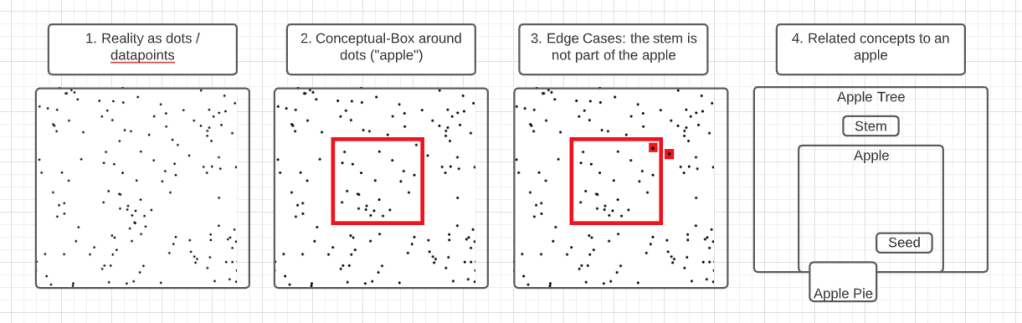
  1. Visualize the raw data of reality as dots on a piece of paper
  2. Put boxes around certain dots to indicate helpful concepts (Example: that data we are receiving from our eyes in an “apple”)
  3. Consider the borders of the conceptual-box for edge-conditions (Example: is the stem of the apple part of the apple or not?)
  4. Consider how those same dots can be part of other conceptual-boxes (Example: that apple is fully part of the tree and the apple pie is partly made of apples)

This geographic way of thinking aligns nicely with the previous three questions:

  1. What are the dots inside the conceptual-box? (evidence)
  2. Are there edge-condition dots that don’t belong in the conceptual-box or others that should? (partiality)
  3. Are there other conceptual-boxes that contain some of the dots? (plurality / other explanations)

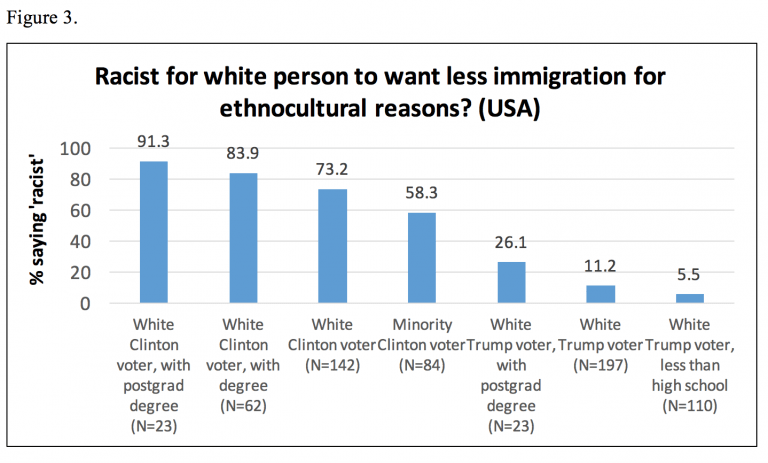
Let’s go back to the curious automatic “thought” that immigration restriction is racist.  We can do this by looking at polling data in response to the question “Is it racist for a white person to want less immigration for ethnocultural reasons?”  We get this polling data from Eric Kaufman author of the book Whiteshift: Populism, Immigration, and the Future of White Majorities

(Image from: https://blogs.lse.ac.uk/politicsandpolicy/antiracism-norms-and-immigration/)

What we see from the polling data is that there is not agreement and that different types of people responded in different ways.  Everyone most likely agrees (based on their programming) that racism is wrong.  Yet some people were seeing racism and others were not.  We can use the three thinking questions (or geographic modeling) to attempt to gain some insight.

Let’s consider the first thinking question: “What’s the evidence for this?”  Well, it seems straight forward that racial preferences are racist.  Some would further say that racial preferences imply you consider certain races superior to other races.  So why isn’t there unanimous agreement?  Maybe the next question will provide an answer.

So, let’s consider the second thinking question: “Could this be only partially true?”  This seems to be where much of the disagreement arises from.  Are all racial preferences racist?  Are dating preferences racist because you are physically more attracted to members of your own race?  And what about cultural compatibility in your dating preferences or in where and with whom you want to live.  And what about a sense of responsibility and aesthetic concern for your cultural and ethnic transmission (from parents to children)?  And what about wanting to slow ethnocultural change to limit cultural disruption?  In the geographic way of thinking these are edge-conditions of the conceptual-box “racist”.

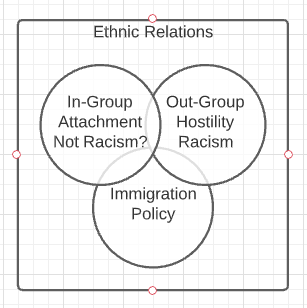
And finally, let’s consider the third thinking question: “Could there be other explanations?”  The other explanation that Kaufman offers is to step back from racism and say that racism is a subset of ethnic/racial relations.  He says that ethnic/racial relations can have at least two subparts: (1) outgroup hostility (racist) and (2) ingroup attachment (fewer people consider this racist).  Therefore, wanting to reduce immigration can be about hating outsiders or it can be about an attachment to the current ethnocultural makeup of your society and an associated preference to limit disruption to that ethnocultural makeup.

The geographic conceptual-modelling method visualizes the three sub-concepts: ingroup attachment, outgroup hostility, and immigration policy as overlapping circles (box-based Venn diagrams are ugly) within a larger conceptual-box of ethnic-relations.

Through the more deliberate process of either asking simple questions or through conceptual-modelling we are able to move beyond the “not really thinking” of most people and into actual thinking.

Summary

  1. Humans-don’t-really-think: “humans get answers automatically from their meat-brains; and rarely bother to question those answers”
  2. A simple way to do more deliberate thinking is by asking and answering a few questions:
    1. “What’s the evidence for this?” “concept-composition
    2. “Could this be only partially true?” / “Yes, and no…”: concept-partiality
    3. “Could there be other explanations?” / “Yes, and other explanations too…”: concept-plurality
  3. You can also use visualization (concept-modeling) to help your understanding. Visualize reality as dots on a piece of paper (raw-data-of-reality) and concepts as boxes that contain those dots (conceptual-boxes) and then ask the following questions
    1. What are the dots inside the conceptual-box? (evidence / concept-composition)
    2. Are there edge-condition dots that don’t belong in the conceptual-box or others that should? (concept-partiality)
    3. Are there other conceptual-boxes that contain some of the dots? (other explanations / concept-plurality)
  4. Warning: thinking is not just about the search for truth.  A large part of thinking is about communication and collaboration; and those activities require that people mostly agree on how to interpret things.  When you start thinking differently you can cause social conflict and get yourself in trouble.